Reimagining the Indian laundry mobile app experience
Team
Solo designer
Role
Research
Design
Prototyping
Timeline
1 month
Jul 2026 - Aug 2026
Type
Personal project
Why this problem?
I audited 7 laundry apps from India and found most of these did not focus on visual design. Moreover, they functioned just as a pickup-booking tool.

Tumbledry

Laundrokart

UClean
Setting context
Target users
Based on conversations with laundry service staff, I identified 3 types of urban Indian laundry users
Sunny

"I cannot invest in a washing machine"
Cost-conscious user
Rahul

"I do not have time to manage weekly laundry"
Time-constrained user
Sneha

"My duvets require dry cleaning"
Special-treatment user
Assumptions and design implications
I made 3 assumptions taking into account this was an early stage, online-first startup
Staying competitive
This meant offering the 4 core services like most other laundry services: wash, wash and iron, dry clean, iron
Hiring gig workers
This enables regular pickups within 2 hours. Users would place instant orders just like quick commerce apps. They schedule a pickup during non operational hours.
Central processing facility
Pricing strategy
We had 2 options for the pricing strategy for our services:
Weight-based
Reasoning
Optimises bulk item intake
Ideal for mature companies
Benefit and tradeoff
User just books a pickup service
User knows about cost after pickup
Item-based
Reasoning
Optimises unit economics
Ideal for early stage startups
Benefit and tradeoff
User selects all items upfront
User knows cost upfront
Most laundry services opt for a hybrid pricing strategy model. We specifically opted for item-based pricing for all services based on the benefits and tradeoffs.
Service
Wash
Wash and iron
Iron
Dry clean
Competitor pricing strategy
Weight-based
Weight-based
Item-based
Item-based
Our pricing strategy
Item-based
Item-based
Item-based
Item-based
Solution prototype
We came up with laundry app called FreshFold that caters to urban Indian audience
Supporting flows (past orders, profile, search) are out of scope
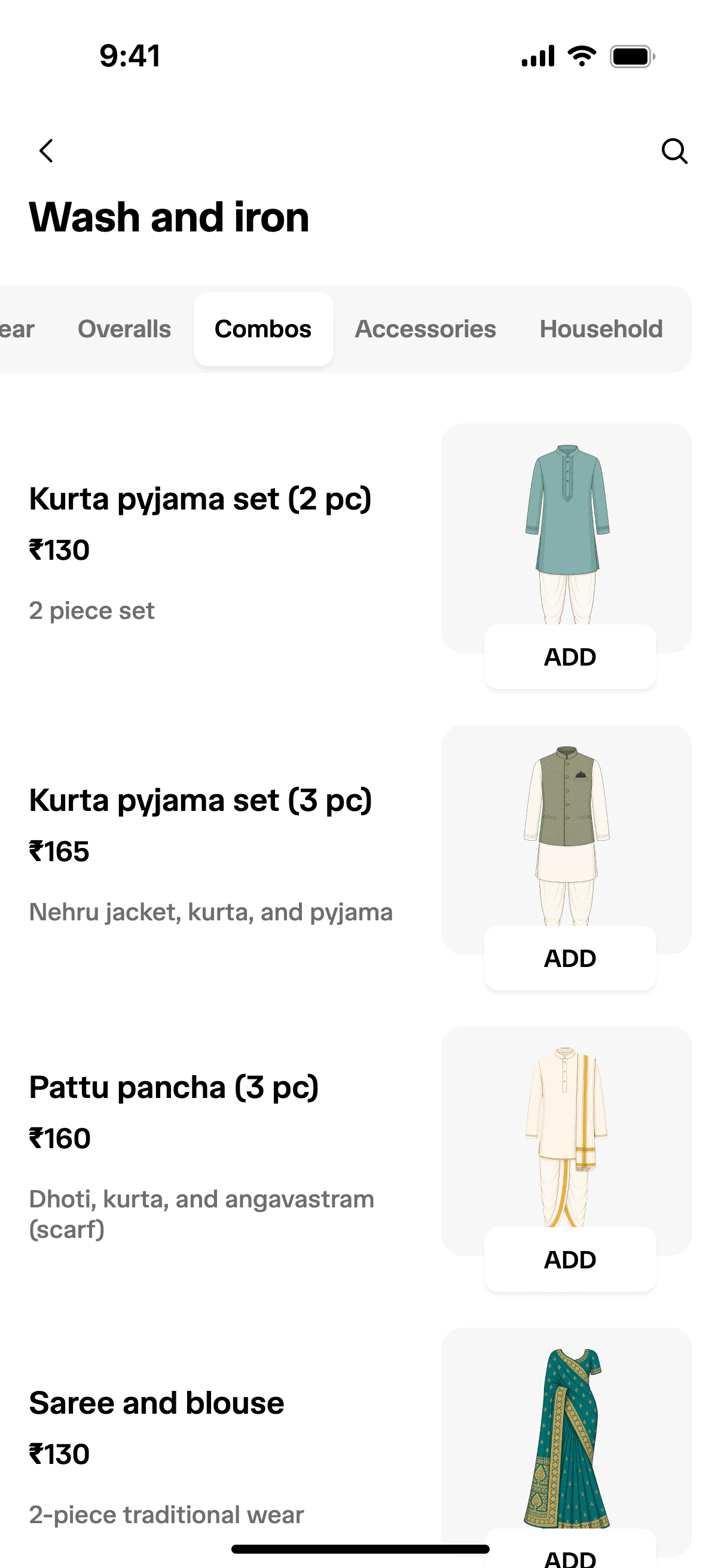
Some items are available in specific services only, e.g. most ethnic wear (combos category) is dry clean only
Design decisions
User journey for placing an order is as outlined
Service selection
Item selection
Review items
Checkout
Track order status
Based on this, I identified probable problems and edge cases:
Problem: choosing the right service
The garment care label is the source of truth for choosing the right service, but it can be missing or unclear. So we need to provide some general guidance for service selection.
Fabric information helps choose the right service


Users may not realise household items are serviced too
Problem: distinguishing between similar items
Users might not be aware of the differences between items such as
a sweater and a sweatshirt
a dohar, comforter, and a blanket
So we designed the experience to eliminate any confusion.
Grouping items with same construction and functionality
Relevant description to differentiate between items with similar functionality but different construction


Category navigation making it simpler to find items
Images for quick selection and additional identification cues
Edge case: cannot find an item
In the unlikely event that a user cannot find an item while searching for it, we let them submit an item suggestion. The support team would review and add the item if needed.


Edge case: handling undergarments
Our pricing models dictates that the pickup staff would count items for each type and each service during pickup. Users may find this interaction awkward with their undergarments.
So as an exception, we let them add undergarments in form of weight buckets. These would be picked in separate weighted bags and won't be counted.
Measured in weight brackets, as an exception

Problem: reviewing high volume basket items
Users usually place high-volume laundry orders, around 10–15 items across different services. Hence they'd likely want to review item quantities before placing an order. So we offer separate screens for basket and checkout.


Default 2 hour pickup
No specific delivery timing, making order tracking essential

Video with order status transitions
Place an order with this working prototype
Additional functionality
Tracking order
We let user select an order delivery date. However the delivery might happen any time throughout the working hours of a day, similar to how Amazon operates. Hence we provide order tracking functionality for users to track their deliveries.
Tracking status with relevant visual cues
Relevant CTAs based on tracking status
Search function
We designing the search screens based on the assumption that the search terms would be either of these:
individual item, such as a shirt, jeans or kurta
specific category or use case, such as ethnic wear or office wear


Subscription service
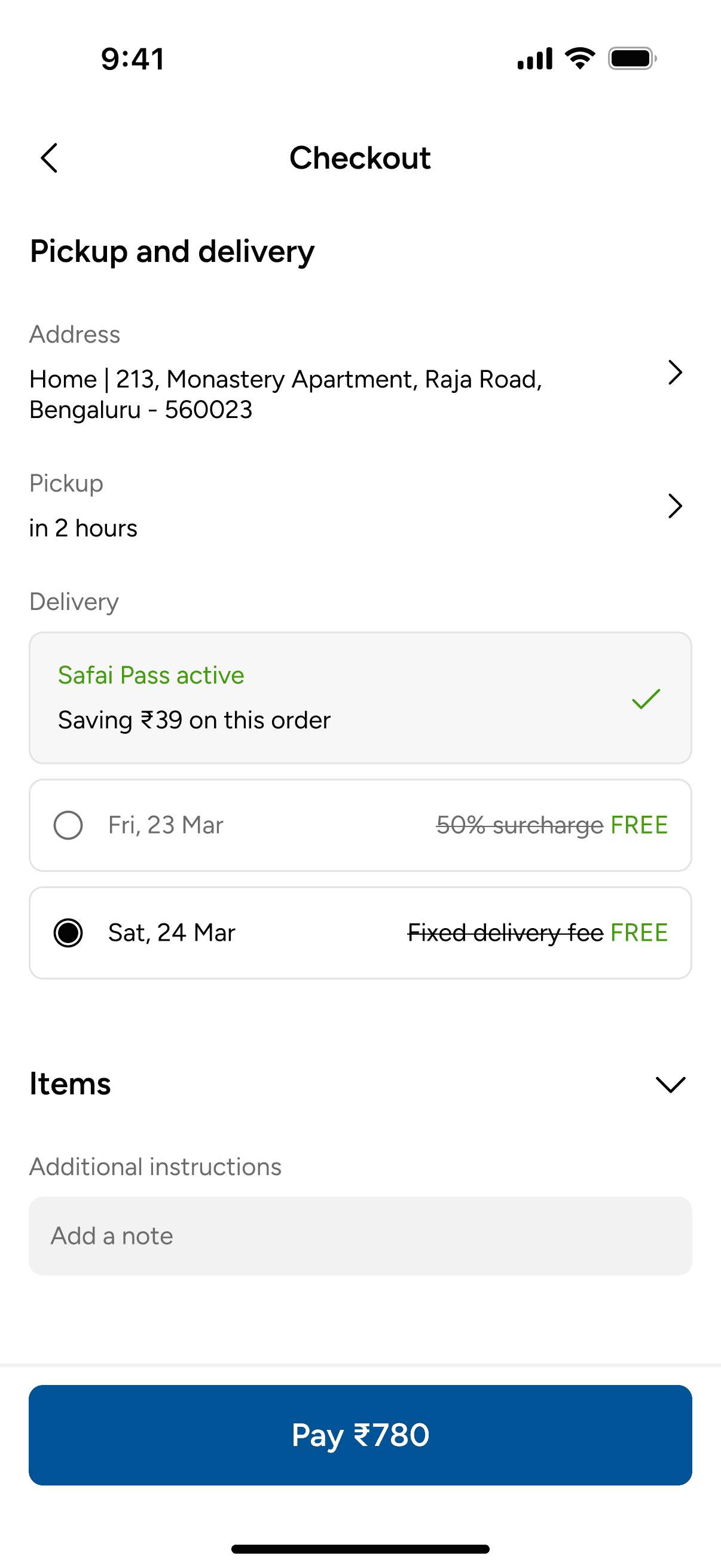
Safai Pass encourages repeat orders for frequent users. Users can add it during checkout or manage it from a dedicated screen.


Iterations
I explored multiple directions for the most information dense screens. These iterations did not make the cut, I enjoyed designing them nonetheless.
Item selection screen


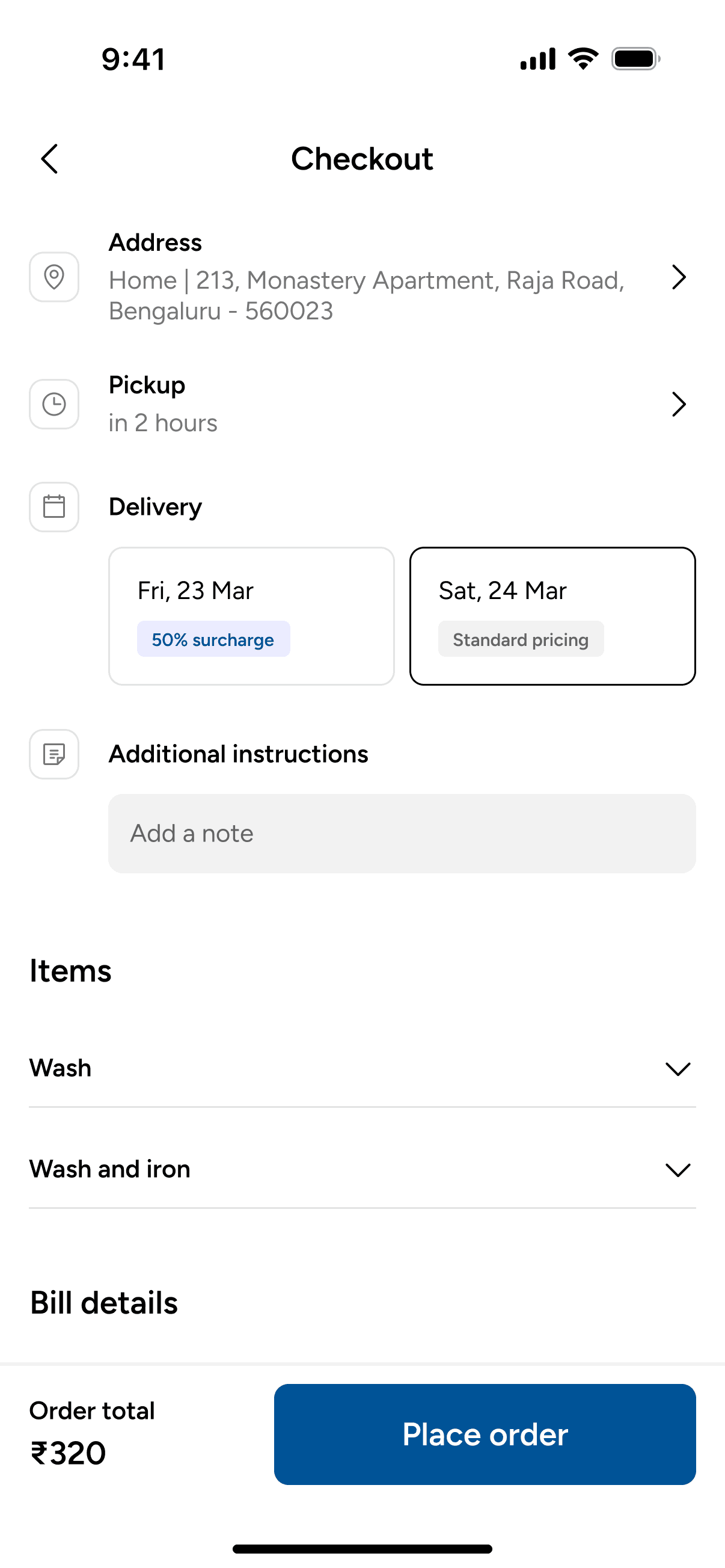
Checkout screen
Learnings
Gather enough clarity about the problem statement, ask questions and list assumptions before designing.
Iterate on designs and seek continuous feedback from mentors to improve visual design, user experience and the overall flow.
Do not get attached to one solution too early. Evaluating the trade-offs of different approaches helped me make better design decisions.